For Claude Code
Run Claude Code in parallel without ten terminal tabs
Your local Claude Code and plan, organized as browser windows on one canvas.
Demo opens in this tab, no account required.
What Claude Code gains outside the terminal
- Every session in view
Each session is a card with its status and latest reply. Agents waiting on you stand out.
- Your Claude plan, your binary
Runs your unmodified claude CLI. Sign-in stays local and never leaves your machine.
- A plan limit is a pause
At a limit, the agent waits for the reset or switches to another Claude model.
How limits work- Undo for every turn
Automatic snapshot before each turn. Edits end with View and Undo.
The jail and undo- The terminal, when you want it
Terminal view opens Claude Code’s native UI on the same conversation.
Opus for the hard part, something else for the rest
Switch models between turns. Moving to GPT or Gemini carries over the current context automatically.
Agents and models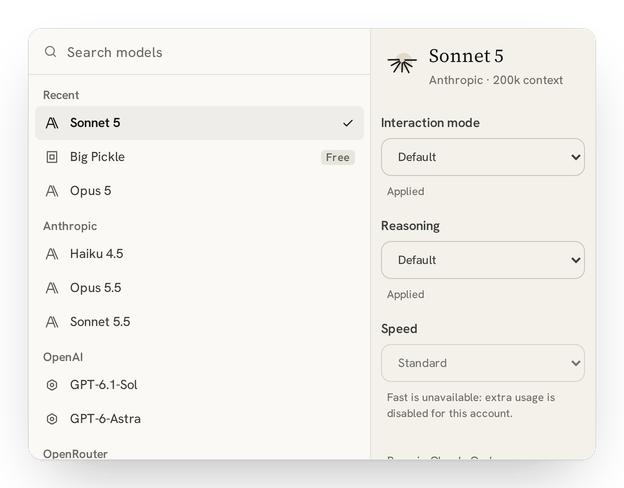
Claude Code on myth/acc
Is myth/acc an official Anthropic product?
No. myth/acc is independent and runs the Claude Code CLI you install and sign in to yourself.
Do I need an Anthropic API key?
No. Sign in with your Claude subscription via claude auth login, or use an API key if you prefer.
Can myth/acc see my Claude login?
No. Authentication runs locally in Claude Code; myth/acc never sees or relays your credentials.
How many Claude Code sessions can I run at once?
As many as your machine and Claude plan allow. On Free, parallel agents still count as one clock hour.
Does it run on macOS?
Yes. The daemon runs on macOS, Linux and Windows (amd64/arm64). The canvas opens in any modern browser.
Keep reading
- Claude Code usage limitsHow the 5-hour and weekly limits work, and how to let agents recover automatically.
- Git worktrees for Claude CodeOne checkout per session prevents file overwrites, though ports and services stay shared.
- Claude Code on WindowsChoose native Windows for simplicity or WSL 2 for Linux toolchains and sandboxing.